
Lunchtime Response: Pearl Binder’s Russian Railway Journey
Hello everyone, and thank you so much for coming to this Lunchtime Response.
My name is Natalja Poplavska, and I am a visual artist and a photographer. I volunteer here at Towner Gallery.
I really appreciate that you have joined me today to share this space and my ideas.
In my work, I explore the themes of memory, human presence and time. As a photographer, my job is to capture the invisible threads that connect who we are today to where we come from.
Today, I want to talk about how memory plays a fascinating game with us. It acts like a hidden trigger inside our minds. We go about our daily lives, and we never truly know when it will wake up or what exact detail will suddenly return us to a specific moment from our past.
This is exactly what happened to me when I walked into this exhibition. I was just looking around, but then my eye instantly locked onto a specific lithograph by Pearl Binder called Russian Railway Journey.
When I first looked at this lithograph, I was confused. I didn’t understand why these people were positioned so strangely. But then I read, I read the title Russian Railway Journey. And the trigger in my memory went off. I smiled because I recognised it. I remember my own childhood, when I was a little girl, I used to travel by train with my mum, dad and brother from Rēzekne to Moscow. Rēzekne is the nearest town to our village in Latvia. We usually travelled all night, sleeping in the platzkart or coupe trains. I can still feel the unique atmosphere of those journeys. Usually, people on the train would eat food they brought from home, like boiled eggs, potato, fried chicken and homemade cutlets.
But I remember one specific journey very well. We were travelling by train to Moscow, and a kind stranger and gentleman sharing the space with us treated me and my brother to fresh strawberries. It was such a special, beautiful moment for a child. Total strangers would share food and tell stories, turning the carriage into a temporary family.
Pearl Binder, a British artist, captured this exact human reality in 1935. When I saw her lithograph on the wall, I asked myself: what was a British woman doing in Russia?
I started searching for information and discovered that she had actually travelled there and published a book in 1936 called "Misha and Masha”, filled with stories and drawings. Misha and Masha are common Russian names. And by the way, my younger son’s name is Misha.
I must be honest with you. I haven’t read the whole book from cover to cover. There are more than three hundred pages. But I chose some specific pages that mirror my own life and memories.
Let’s start reading some fragments.
“A winter’s day. A group of us kids standing near an iron fence. We were daring each other to touch the railing with our lips. One of the kids kept his mouth too long against the freezing iron. His lips bled and a burned spot popped out on his mouth. We ran away. We were afraid his mother would beat us.”
Did you ever try to do this? But maybe not here in England — winters are not that cold.
“As kids picked up everything like monkeys. Now we started playing N.E.P. men and bandits, and detectives. Sherlock Holmes and Pinkerton were our idols. Kolia was determined to be Nikolei Holmes, and he kindly permitted me to be Oleg Watson. All was in order except the pipe. He had to smoke a pipe. Where and how? First we tried smoking paper… that was no good. Next we tried smoking dry leaves. That was already an improvement. Kolia then started lending out books from the ragged library of ten detective stories he kept hidden in an old trunk, in return for cigarettes. We worked awfully hard on our detective careers. We goaded other boys into stealing the dolls belonging to the girls who played in the courtyard in order to be able to track them down afterwards.
Nikolei Holmes and Oleg Watson didn’t last long. Soon I found a book by Jules Verne in the school library and dreamed of other conquests. Kolia didn’t want to stop his detective career, at which he was doing brilliantly, so we parted.”
Did you ever play games like that? Me, not. But I did read these books as a child.
“We played in the street mostly games of our own invention. Uncle Vollodia stole a lump of chalk one day, and drew a twisted face on the stone wall at the back of the house. As he drew, we all sang: ”
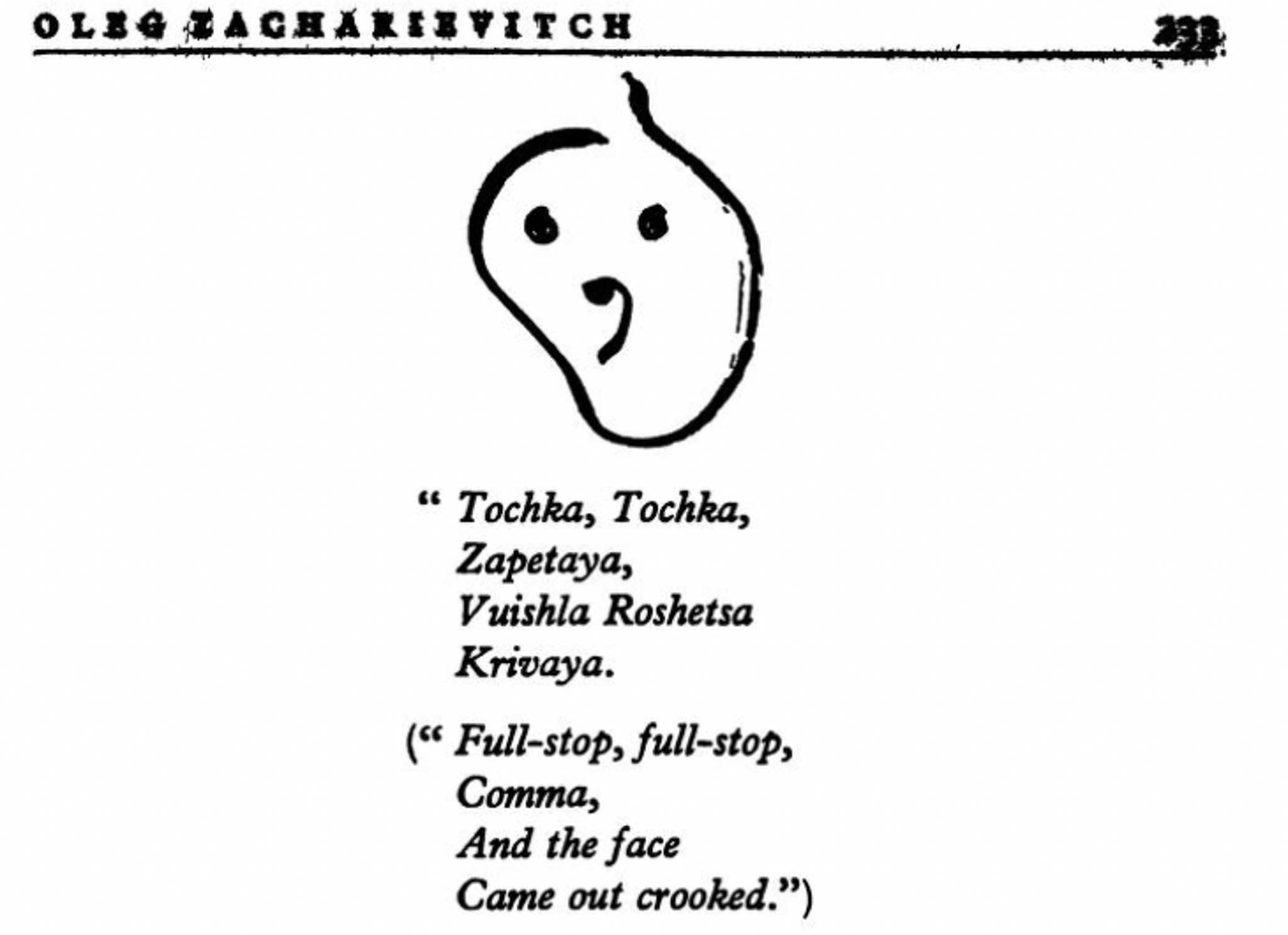
I was born in 1976, and this book was written about an earlier generation. But I still sing this song to my granddaughter.
Let’s continue with the story of Oleg, where he describes his student years in Moscow.
“They were building Student City on the outskirts of Moscow, but it wasn’t half ready yet. The hundred extra students waiting for it were accommodated in the meantime in a huge wooden barracks near by, in three long rows of iron cots.
Shura and I were to receive the official student stipend, free accommodation and our food at especially cheap rates.
There were students of thirty-seven different nationalities at G.I.K…. a lot of them were primitive, and most of them speaking no Russian. We found it a bit disturbing, did Shura and me, especially when some of the Caucasian students would start dancing the Lezhinka in the dormitory at three o’clock in the morning, or one of the Uzbeks would bring out his string lute and set up a mournful chanting before daybreak. There were heated discussions that went on for days and nights and kept us awake, between various lads and girls from the other side of the Georgian military highway and God knows where else, which we didn’t dare interrupt because these races are passionate as devils and they all carried knives in their belts.
Well, one fine day Shura and me and twenty-three other students took up our mattresses like Lazarus and besieged the half-built Student City. We camped in the Red Corner and refused to budge. So the director had to make the best of us and squeezed us in somewhere, five to a room. They were building madly all the time but there was never enough accommodation.
G.I.K. had already eight hundred students then, all studying hard to make up the gaps in their education and to catch up with the rest. Shura and me, we swotted political economy, dialectics and political history, day in and day out and coached each other as well as we could. I remember I was mad about Goya and Jack London then, both of whom I had just discovered. Our official lessons also included film theory and practice, languages, actual making of small film studies, physics, drawing, music and biomechanics. All the same, although we wrote a nice little scenario about the Donbas during the summer holidays, we didn’t shine in our examination that first year, I can tell you.”
This description of 37 different nationalities living together perfectly mirrors what my father used to tell me. I saw it myself in his old photographs from his student years at college. There were people of completely different nationalities from all over the Soviet Union living and studying together, just like in this book.
Now let’s move to the story of Nina Petrovna.
“Her mind relieved of this heavy anxiety, Nina Petrovna was now sent to school. It was an astonishingly large school. She had never seen so many children before in her life. They teased her at first because she could only speak White Russian. She shared lodging near the Commune Ploshad with her brother Makar, and soon applied to the Pioneers for membership. She was very happy with the Pioneers. They helped her to learn to speak Russian and they helped her in her studies and in her games. She made many new friends in the summer of 1925 went off with ninety-nine other Pioneers to the Crimea for the three months holiday by the glittering Black Sea.
School days passed briskly. When she was seventeen she was transferred from the Pioneers to the Young Communist organisation, and in the following year graduated from the seventh class at school.
She was anxious to learn constructional engineering, so she entered the Transport Section Technicum for Railway Construction. This wasn’t at all according to plan, because Mother had said to her before she left home to go to Moscow:
“Don’t you worry Ninushka, what you will be is an agriculturalist of course.” But Makar wanted her to be an engineer. She thought it over and decided it would be more interesting to build things on top of the ground like Makar instead of making things grow out of the ground as her father had done.
So she started step by step to learn constructional engineering from the very beginning, doing practical work along with theory. The first practical jobs she was given were the simplest manual labour, carrying planks of wood and loads of earth. Nina was twenty now and a brigade leader.
For her practical work in the second term she was sent all the way up to Siberia, where three hundred kilometres north of Kazan they were building a road. She was given the job of arranging all the meetings so that she should get experience in organisational work. Construction went with a swing. She was very strong and healthy and the life suited her admirably.
Makar, going from success to success, was already an Orderbearer and a famous personality among the engineers who were changing the face of Russia, making arid tracts soft with water, and causing gracious new cities to appear on the steppes with magical swiftness… changing the course of ancient rivers, and spanning raging torrents with delicately drawn girders stronger than steel.
It was a very proud Nina who was ordered for the second part of her graduation test to assist her brother Makar in the concretelaying for the mighty new bridge over the Dnieper, not far from Dnieprostroi.
There was a certain engineer working there named Stepan Nikoleyevitch, a friend of Makar who was popular with everybody. Nina no sooner saw him than she fell in love with him. Her peasant reserve caused her much anguish, for she wanted to let him know her feelings before the construction was finished and they scattered. They walked and talked in between work and at last made a plan. He lived in Sverdlovsk, Nina in Moscow. The plan was that if she still wanted to marry him she should join him in Sverdlovsk the following January. If not it meant she didn’t want to.
Back in Moscow, she got through her examination creditably, and in 1933 graduated.”
This story mirrors my own life in two beautiful ways.
First, in my childhood the absolute best pioneer students were also rewarded with a one-month trip to the pioneer camps called Artek by the Black Sea. It was the ultimate dream for all of us, but I never managed to become the kind of student who would be sent to Artek, even though I was actually a very good student.
Second, this is exactly how my parents met. After finishing his studies in Riga, my father received his state allocation and was sent to the other side of the Soviet Union to Ust-Kamenogorsk in Kazakhstan. He went there for work experience and that is where he met my mom. And they got married, and I was born there too.
When I was one and a half years old, my parents moved to Latvia, where my father originally came from. So my mum had travelled with him to the other side of the Soviet Union, a distance of around five thousand kilometres. That was a very long way from home for her!
It echoes a pattern of life that later appeared in my family story.
And finally, I want to read one last fragment from this book. It is beautiful description of simple blissful village life that completely stole my heart.
“I soon felt at home in the village of Ryabinovka. Great-Uncle Pyotr, his wife and children, Grandma and I, shared their whitewashed cottage and their lovely greasy Schshee which they ate out of one big bowl, sitting round a low table and everyone dipping. I learned to drive the big farm horses, sitting on their strong necks in the warm sunshine, and went gathering watermelons every day in the fields with my relations. I lay on my back, spitting sunflower seeds at the sun and had not a care in the wide world.
It was too blissful to last.”
This passage mirrors my own childhood perfectly. I used to eat exactly the same Shchi — a traditional Russian cabbage soup — at my grandmother’s house in Latvia. And I used to collect watermelons from the fields near my great-grandmother’s house in Kazakhstan.
This book showed me that the human core does not change. We all share meals from big bowls. We all dream under the warm sunshine. And we all carry these blissful memories inside us, no matter where we live.
Thank you so much for your time and for sharing these memories with me today.
Excerpts from Pearl Binder’s Misha and Masha: Stories and Drawings (1936).